Tuesday, November 19, 2013

Book #90 was a bit of a bummer


I picked up the wrong book at the library--it was supposed to be All Of A Kind Family by Sydney Taylor, but instead I got All Of A Kind Family Uptown. A sequel, one of many.  I don't think I'm going to finish it.  The reading level is about fourth grade and I could knock it off in an hour, but why?

I don't mean anything negative by this, it's simply lack of interest.  At this point in my reading life, the book has nothing to offer me.  If I were an eight-year-old girl I'd be happy with it--maybe not as much as with Harriet The Spy or one of the Danny Dunn series, but happy enough to search out the rest of the series.  They're sweet little books about a family of kids growing up in New York in the years after World War II...oh, shoot!  I do need to read them for historical data.  This one was published in 1958.

Erase that!  The time period for the book was during the war, not after it.  It turned out to be pretty good--for an eight-year-old audience.

Monday, November 18, 2013

Book #89 and major spoilers

The False Prince
            by Jennifer A. Nielsen


I hate stupid author tricks.  Like hiding the main character's history and revealing it suddenly, for shock value.  Should I call it schtick value?  Characters should stand up for themselves and draw me into the story so deeply that I forget there even is an author.  The author shouldn't suddenly shove himself into the story and jerk it around, just to see how badly he can mess with my mind.  I want him to create a world for me--not play silly games.  Blah.

I tried to explain this reaction to my daughter and she said that every author hides part of the protagonist's backstory, revealing it slowly as the plot progresses or "big bang" to make an impact.  She may be right, but in that case the author usually drops hints and suggestions that something is coming.  This makes us pay more attention to our characters, wondering...wondering....then BLAM!  So that was the point!  Suddenly you understand everything.

Not this book.  It was more like, BLOOP!  Do I feel like an idiot, or what?  And incidentally, the main character is an idiot, too, and the plot is suddenly revealed to be as holey as Huck Finn's breeches.

Oddly enough, I liked the characters enough to want to finish reading the trilogy.  But not with the same excitement I had when I started it.


Sunday, November 17, 2013

Everyone else liked this better than me

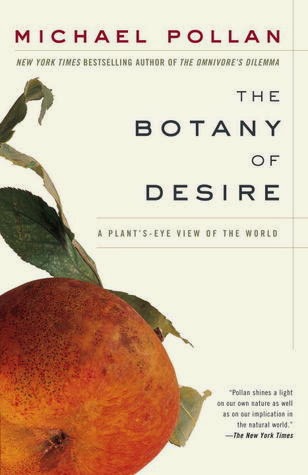
Not much reading got done this weekend, but I did manage to finish The Botany Of Desire.  I have mixed feelings--parts I liked very, very much, but other parts I disliked, almost enough to poison the whole book for me.   The parts that deal with history and culture are fascinating and revealing.  The Johnny Appleseed chapter was a true eye opener.  You know about apple seeds?  Well, I didn't either--but I do now.

Mr. Pollan's remaining three sections deal with tulipmania in Holland, the genesis of modern-day cannabis production, and the contribution of the humble potato to agricultural knowledge.  Great subjects.

But I don't the way he writes whimsical speculations as if they were facts.  The apple and the tulip sections are full of statements that aren't fact or even scientific theories undergoing serious consideration.   Some of his statements (a.k.a. speculations) read more like flights of lively fancy.

"When lack of food killed people, people judged body fat to be a thing of beauty."  "Try as they might, people have never been able to domesticate the oak tree, whose highly nutritious acorns remain far too bitter for humans to eat."  "...a well-developed culture of flowers is a luxury that most of Africa historically has not been able to support."

 Not that they're not interesting speculations--sometimes they're good jumping-off points for lively debate.  At other times, just beautifully drawn fantasy.  You might even say, poetry.

So...good book but be careful what you quote.


Good cat, bad picture.  She apparently knows how to use a bed.

Friday, November 15, 2013

Audiobook ambrosia

The Guernsey Literary and Potato Peel Pie Society
by Mary Ann Schaffer and Annie Barrows

I wish I could give this four-and-one-half stars because it's just so darn delicious. I should read it on paper to see if has the same kick.  The audiobook was narrated by four voices, each taking on multiple characters as they read the letters back and forth between Juliet, her publisher Sidney, and the friendly people on the Isle of Guernsey, off the coast of France.  It takes place immediately after World War II and gives a vivid glimpse into people's experiences during and after the war.


As Juliet gets to know the people, and herself, and they get to know her, and themselves, the magic unfolds as gently and delightfully as a time-elapsed blossom.  Don't expect high drama, scandal, murder or mayhem in these pages--but be prepared for someone to get a smart slap in the face when needed.


Thursday, November 14, 2013

Great book. Want more.

                 Come A Stranger
                 by Cynthia Voigt

This fifth book in the Tillerman Cycle was a little hard to get into.  The main character wasn't as interesting as previous ones have been--her challenges seemed trivial; her worries manufactured; her personality undeveloped.  I shouldn't have worried--she grew into still another of the marvelously complex Cynthia Voigt creations that I've learned to expect.

It's amazing that the five books in the series have all been interconnected despite the difference in time and perspective.  She must have planned this in advance, but I don't see how.  I don't dare read an interview with the author--not until I've finished all seven books in the series.  An interview might contain spoilers.

I must read the next two books, but unfortunately there was a wreck right at the entrance into the library parking lot.  Tomorrow....


Changing the subject, about a year ago I made a list of the "recently added, unread" books on my bookshelves.  There were 21 of them.  I put them on a to-read list and added the Shelf Discovery books and came up with 100 books.  I've been working off this list, in order (mostly), all year.

A few of the 21 original books have since gone to the Half-Price Books buying area; a few more to the library donation stack.  I also got rid of six or seven books from a mystery series that I didn't expect to ever read again.  And now...my bookshelves are fuller than they were before!

This is a sad state of affairs.  IMHO, a bookshelf should only hold books in the categories below:
    plan to read,
    intend to read again someday,
    useful for reference material, and
    may never read again but can't bear to part with.

So there is my goal for 2014--trim the shelves.
Step 1 of my goal is to identify the problem, and this I have done.  I have made a list of 53 books that are currently occupying space on the shelves.  A very few of those are books I read many years ago and need to re-read, but most have never been opened.

So, here are my rules.  (Last year's rules with slight modifications)
1. Must read the first two chapters of a book before giving up on it.
2. Any books that are given up on must be blogged about, explaining my delinquency in full.
3. An occasional swap is okay but don't make a habit of it.
4. New books can only be added at the list's indicated insertion points. (no matter how appealing they are.) 
5. Exceptions to #4 are only allowed if the new book is a library book or some other sort of temporary loan.
6. No more than 20% of reading can be done during my lunch break.

Wednesday, November 13, 2013

Slogging through to prove a point?

America Aflame: How the Civil War Created a Nation by David R. Goldfield


I shouldn't make too much a big deal out of this, but I can't help myself. For all that the book is and isn't, it is not a demonstration of "How the Civil War created a Nation."  Maybe it should have been subtitled, "How the Civil War almost prevented America from becoming a nation."  Occasionally--very occasionally--the title was illustrated in the text--but not enough to justify the subtitle.

The nation-building that occurred during the period was only incidentally a consequence of the war.  When the southern states succeeded, the departure of their Democratic Party forces from congress left a republican majority.  That, plus a strong president, allowed our government to get things done in a hurry--the  Homestead Act passed, granting 160 acres of public land to farmers; a Department of Agriculture was established; land grants were made to finance the transcontinental railroad; government bonds were issued to pay for the war.  The National Bank Act of 1863 established a national currency.  The North was becoming a nation--the South didn't rejoin until long after the war and reconstruction were over.

The book was full of fascinating facts about a fascinating time in history.  For example:

- Jeff Davis' inaugural address described the constitutional basis for succession and how it "preserved the founding principles of the American nation." It was an admirable speech; convincing even to modern sensibilities. A month later, his vice president Stephens made a speech that declared, "Our new government is founded on [...] the great truth that the negro is not equal to the white man; that slavery; subordination to the superior race, is his natural and moral condition."

- The actual percentage of successionists in the south was nowhere near a majority.  Only in Texas was the ordinance of succession submitted to popular vote--the other states were afraid it wouldn't pass.

- The northerners' desire to prohibit slavery in the territories was not based on moral abhorrence but rather on fear of competition for jobs.  They were, on average, just as prejudiced against the negro as southerners.  "We did not enlist to fight for the negro and I can tell you that we neer shall..."

- I never realized how much Walt Whitman, in his poetry, captured the events and sentiment of his time.  If it weren't for my self-imposed ban on reading poetry, I might be tempted to take up an anthology.  Provided it was cross-referenced with the events on which he was waxing poetic, so I'd know what he was writing about.

That last note pretty much captures my reaction to the book.  I wanted more primary sources and less commentary.  We have transcripts of the speeches; we have Whitman's poetry; we have newspapers and letters from the front.  Those could have been arranged to tell the story better than the book's endless words--words that were frequently hard to read.  His description of the soldier' experiences at the battle of Shiloh was vivid--fascinating--depressing.  But a lot of the exposulatory text was disjointed and confusing--several times I'd get halfway through a paragraph only to look up and think, what the heck is he talking about?

So, if you're a history student wanting an introduction to the era, this book is an excellent jumping-off point.  If you're a casual but knowledgable reader, skip it.  The scope is too large; the focus alternates between macro precision and wide-angle blur.

Monday, November 11, 2013

Nonfiction that's better than fiction

               Dani's Story: A Journey from Neglect to Love
                by Diane Lierow, Bernie Lierow and Kay West


Deeply involving--impossible to put down--and not enough.  More!  I wanted more!

Okay, I admit that a life story of a living person has to end somewhere and this was published in 2011.  She was probably about 10 years old at the time.  The website it refers you to hasn't been updated since 2010.  But I just wanted to know more.

Darn.  I guess people have a right to a little privacy.