Wednesday, June 3, 2020

Liking these better as I go along

Stalking Ground
by Margaret Mizushima

My ratings of the third and fourth books of this series (Timber Creek K-9 Mystery) were high but not stellar. I'd just finished up a couple of very well-written action/thriller mysteries, and these just weren't as good.. I liked a lot of things about them, but the action wasn't up to par, the romantic relationship was soppy, and the author had a weird habit of repeating certain phrases that annoyed me. In particular, every time she takes her dog into action, she "revs up his prey drive with pitter-patter." If it's so absolutely necessary that she does this, despite the fact that he's a magic dog who appears to read minds, can't she vary the wording a little?

I've complained about other things, too. But don't let those grievances keep you from trying out this series--there's a lot to like. She puts some effort into making her co-stars realistic and consistent in their behavior; the plot and action is decently original; at times--like last night right before bedtime--they're hard to put down.

Sunday, May 31, 2020

Mammoth's Ocean Jaunt, Day 3

Tuesday April 6

                                                                             Still round the corner there may wait
                                                                             A new road or a secret gate,
                                                                             And though we pass them by today,
                                                                             Tomorrow we may come this way
                                                                             And take the hidden paths that run
                                                                            Towards the Moon or to the Sun.
                                                                                                                -J R R Tolkien

There had been little or no moon the night before, but Tuesday was supposed to be sunny (and therefore, Tuesday night, mooney). I promised to give myself a long, delicious moonlight walk on the beach that evening. The night before when I'd taken Zack for his final walk, I'd been nibbled to pieces by mosquitoes in the parking lot; but for my moon walk I figured I'd put on some repellent.

Speaking of the night before, wow! had it ever been a reminder of why you don't to camp next to a marsh! (or maybe, you do. I certainly do.)  It was loud out there!  Every frog, salamander, bug and bird was croaking--croaking, creeking, peeping, brrring, and buzzing. Ed went out at about eleven p.m. and reported the next morning that he couldn't hear himself think.

We'd slept with the windows closed, due to the slight chill, so the noise was just a pleasant hum. You couldn't hear the ocean--too far away for that. And although we expected to dream of biting vampire hordes, we slept well.

In the morning I grabbed a quick breakfast and went for a jog. With binoculars, which turned out to be a great thing even if it was against my rules. I saw an odd plover on the ground which let me approach closer than I would expect, but just as I was getting my glasses up it revealed itself to be the same old killdeer. Without the customary squee-squee! racket, I didn't automatically assume it was a killdeer like I would have back home.

Gallinule and Coot:

Then a couple of black-necked stilts adorned the marshes as I jogged past--wish I'd taken my camera! It turns out that although the campground is small, the day use area is large. The road and several parking areas stretch on far enough that two circuits plus a jaunt along the ocean made for a fifty-minute jog. With bird-watching stoppage--I almost for sure saw a caracara flying by but since I didn't expect to see one in the air, I missed the mark on it. I absolutely for sure saw a common Yellowthroat--male, singing in the tops of the low scrub--and a white-tailed kite, perched at the top of one of the few low trees to the north of the park.

<-pied-billed grebe="" p="">
I didn't go fast and I didn't go far, but it was one of the best jogs of my life.

On my return I found Ed still sitting at the picnic table, and he regretfully informed me that a park ranger had stopped by. The Governor of Texas had spoken--all Texas State Parks were closing. We had to be out by five. Oh, well. We'd sort of expected this all along, but the timing could have been better.  If he'd held off until Friday....

We made a half-hearted attempt to find a private park nearby--we called exactly one place, but they didn't take single night visitors. We didn't persevere. For one thing, in my experience finding a nice private park along that stretch of the coast was iffy at the best of times. Most of them were simply glorified parking lots with hookups. And for another, we probably weren't "supposed" to be traveling at all. Texas didn't have a stay-at-home order in place, but a lot of people were doing it anyway.


It just seemed best to go home. The birds and the frogs and the glorious sandy beach would still be there, even if the people were not. But first we took a morning walk.


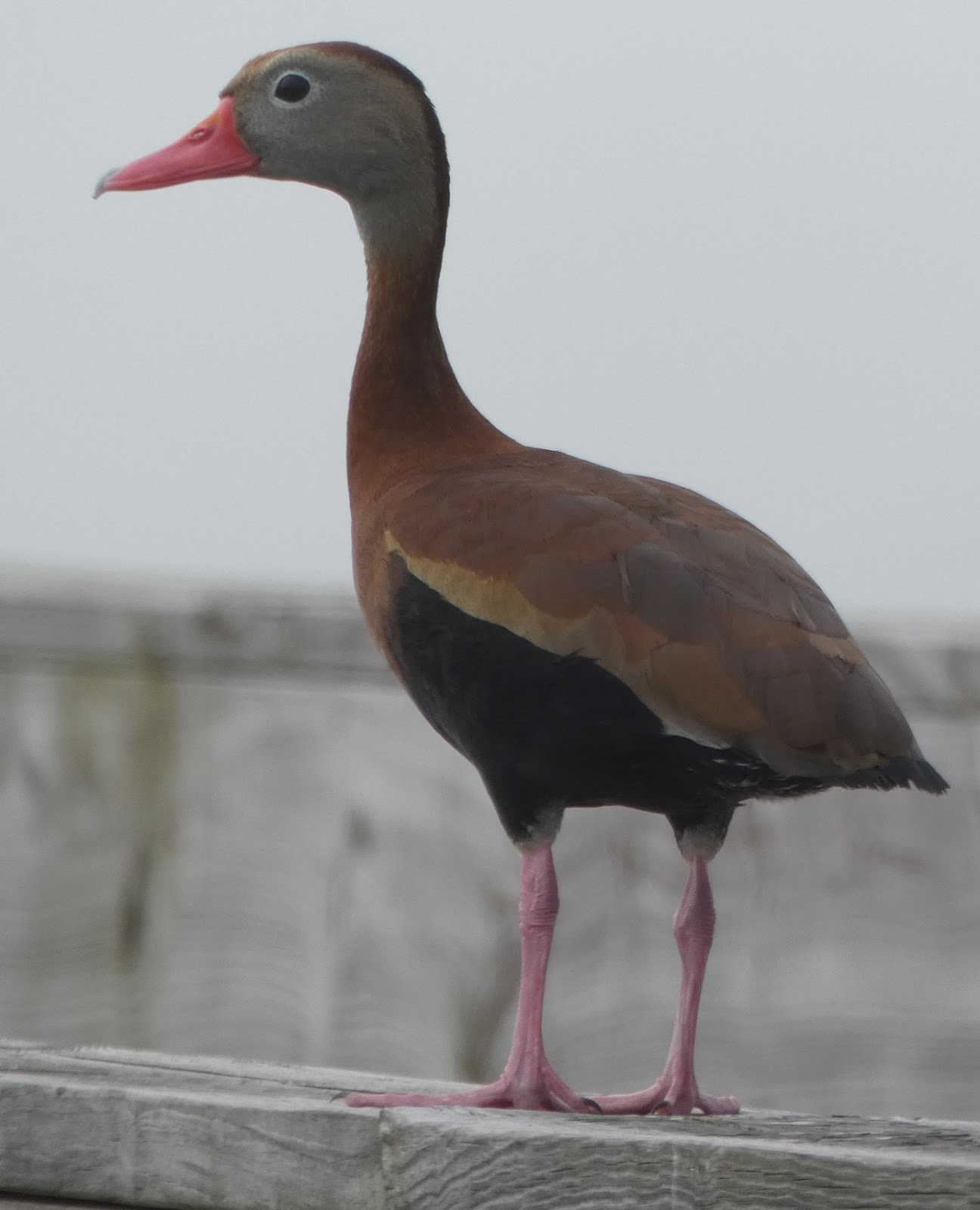
 We headed out toward the boardwalk, and right there, large as life! were a pair of Black-Bellied Whistling Ducks. Sitting on the boardwalk rails. Can you believe the ridiculous color of these legs?


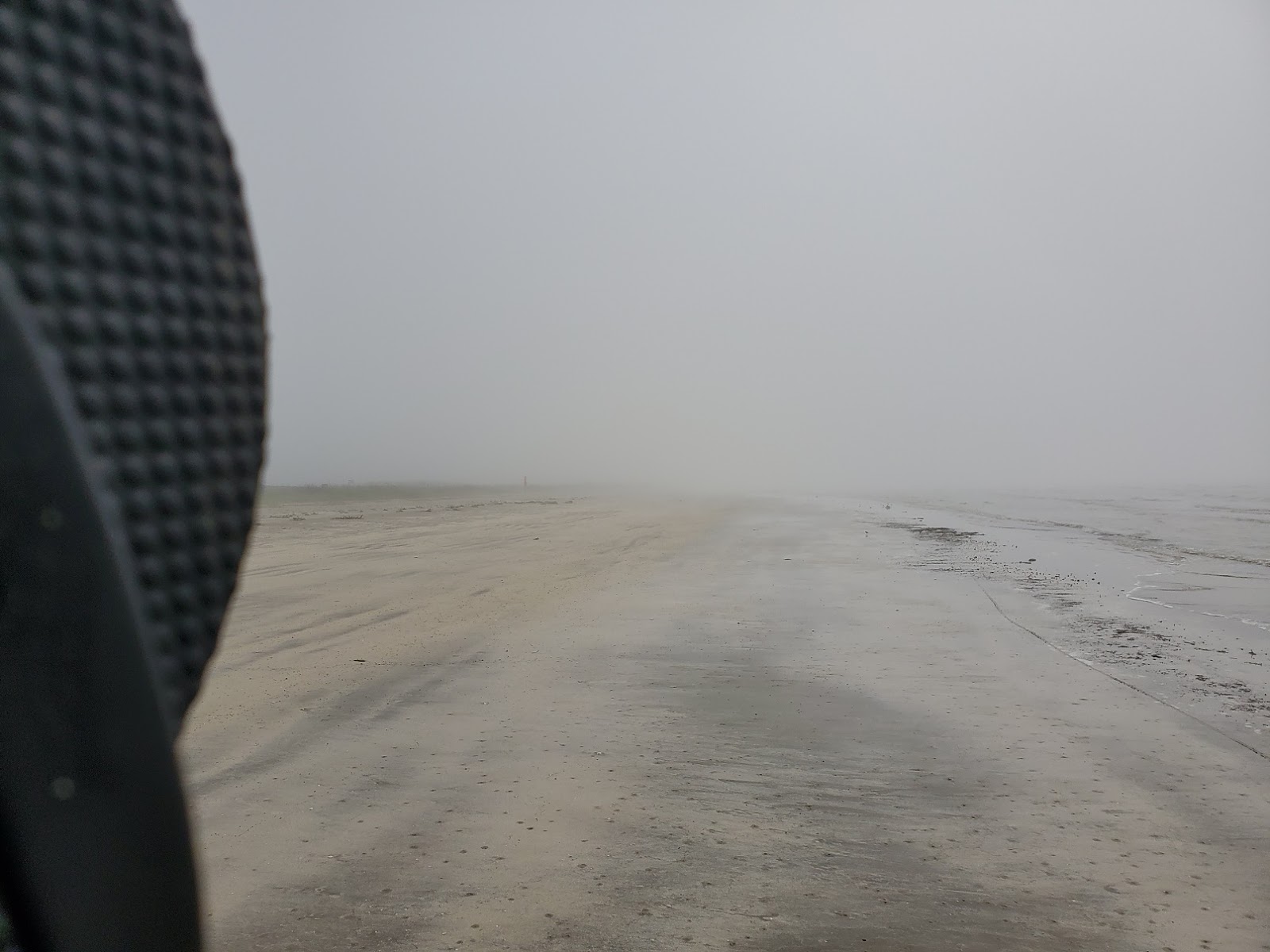
The ocean was much calmer, but a near grayout of spray and mist filled our eyes. (I'd like to be poetic and say tears, but that would be lying. We weren't teary, just disappointed.)  There was a whole flock of White Pelican on the sand, and the usual peep that I had no hope of identifying.


And that was that. We packed up and departed. We weren't in a hurry, but had no especial reason to dawdle, either. We averaged 53 miles per hour for the 343 mile trip, stopping only for gas and a lovely little rest area on US-69 in Cherokee County north of Jacksonville.
  http://www.jacksonvilletexas.com/loves-lookout
 The rest area is placed on a long, flat-topped hill that extends north and south about nine miles. The east side looks over a broad valley - a wide expanse of beautiful scenery as it is described. You can see 30-35 miles.

Arrived at 6:30pm and unpacked. And in the imitable words of Sam Gamgee,
               Well, I'm back.

Birds seen, Martin Dies Jr. State Park:
Common Gallinule, American Coot, Red-bellied Woodpecker, Northern Cardinal, Eastern Kingbird, Northern Parula, Carolina chickadee (v), Caroline wren (v), Great Egret, Little Blue Heron (life bird!), almost certain Wood Ducks but no positive ID, small falcon, Great Horned Owl (2, v), White-eyed Vireo (v).
Sea Rim State Park:
Boat-tailed Grackle (life bird although I know I've seen it before!), Pied-billed Grebe (life bird!), Red-Winged Blackbird, possible Brown Pelican, possible Caracara but no positive ID, Blue-winged Teal (life bird), Black-necked Stilt, Plover sp, Cave or cliff swallow on ground--why?, Killdeer, Common Yellowthroat, White-tailed Kite (life bird), American Avocet (life bird although I'm sure I saw them in FLorida), Black-bellied Whistling Duck (life bird), a whole bunch of peep, White Pelican.

NOTES:
1. Knowing that we can drive about 4-1/2 hours on a full tank of diesel fuel, we should plan our refueling stops in advance rather look them up while we're on the road. My RVParky app will easily find us truck stops on interstates--it has pre-programmed locations for Love's, TA, Pilot, and a couple of other big names. But our last few trips didn't involve interstate highways, so we figured we'd wing it.  But I'm learning that if I attempt to search for "truck stop" on Google, I get all kinds of junk--a few truck stops, sure, but thousands of ordinary gas stations and a sprinkling of other things that don't appear to be fuel-related at all. While traveling at sixty miles per hour down the highway, there is no way to tell the difference. (Searching Diesel Fuel doesn't help, either--it limits me to diesel engine repair shops.)

So, rather than guessing, worrying, and listening to that little beep beep beep sound that lets us know that fuel is running low, I should just plan them out while I have plenty of time to search.  However, I have to admit that on the Lake Livingston trip I had a Buc-ee's stop planned on the interstate, but we chose to skip it. We were running late and worried we'd have to unload in the dark.

2. Always remember to stop at that lovely little rest area on highway 69.

3. Picture taking takes a long time, and picture "processing" isn't all that speedy, either. I keep the camera set on "burst shot" mode, for bird photos, but that gives me all these identical shots that then need to be deleted.

When I'm doing stationary objects, there's no point in it. I need to refresh my memory of how to quickly switch modes, between 'single' and 'burst' shot.

4. Before leaving the fast internet at home, download the park map PDFs to your phone.

5. If you ever get retired for real, make an ocean trip at least once a year. Just because.

6. For now and the rest of your life, never put off things. Do them now--or you may never get to.

Saturday, May 30, 2020

Ocean Jaunt Day 3

Monday April 5

Next day was moving day but there was no rush about it. We only had a two-hour trip. I got in a short jog, only to return and find Ed had done all of the work. My conscience was whispering guilt in my ear...but that's okay. I don't hear all that well these days anyway.


Then on to the dump station, for the first time in our camping experience. (We've never dumped in public, preferring to pump out the tanks into our home septic system.) To get to the dumping station, we had to circle the whole campground on the narrow, twisty roads.

No one was dumping when we arrived, so there was no hurry to park, but still we managed to place the values a few feet too far away for our "stinky slinky" to reach. Luckily Ed had a backup and we hooked them together. Future note: there's no point in trying to squeeze down the slinky--when the sludge starts moving, the expandable hose expands immediately. If you were trying to get some gravity assist, it won't work.

A fifth wheel arrived just behind us, but rather than wait they went down the road to the boat ramp and came back in the opposite direction. That way they could get all set up while we were dumping--shortening their total time. We asked the lady dumper if there was room for us to turn around at the boat ramp and she said yes. That saved us having to drive all the way through the narrow campground again in order to get turned around.

So after leaving the campsite at 11:20, we were passing the park gate at 11:58. Forty minutes seems a long time for dumping, but I would guess one-third of that was winding around the narrow little park roads.

It wasn't too long until we were passing through Beaumont. The traffic was lighter than it probably ever has been and probably will ever be again, so it wasn't bad at all. I doubt if we had to slow down even once. After that it was Port Arthur--but first I had to make us miss a turn at Nederland--stupid Dutch!--and creep along through small streets to get back on the highway going the right way. The phone navigation was working but it failed to tell us to "stay left" at the fork which looked like a main route but wasn't. Turning around and going back was pointless--it would have taken longer than the detour.

Soon we were back on the road and it was clear that we were nearing the ocean! Oil refineries sprouted everywhere, accompanied by trucks of many descriptions. A lot of America's sea coast is a complete and total mess. [refinery] But, luckily, not all of it--when we got out of town and started heading south on SH-87, the refineries (but not the trucks) were left behind.  We couldn't see the ocean, we could only see a field of marshy grass that seemed to stretch on forever...but off to our left, it was bound to be ending up on sandy beaches. And soon enough, when we turned off onto the park road, we were there!


 The campground was flat and nearly treeless, with a single road heading south "alongside" the ocean--paralleling it but a few hundred yards away. (On the map it looks like 400-600') There were pull-through campsites on either side, about 25 total.  About half of them were occupied; the spacing was good and felt uncrowded.

Right next to our site was a little marshy pool filled with reeds and birds: boat-tailed grackles, red-winged blackbirds, a common gallinule--yes, the same bird I'd spent so much time trying to photograph across Steinhagen Lake, coots, and a pied-billed grebe. The latter was a new one for me despite the fact that they're exceedingly common. I'd never gotten close enough to positively identify one before.

And over the pool we could see the ocean!


After a quick setup we took a stroll along the raised walkway to check out the water.


It was very, very windy.  Not exactly cold, but I was wearing shorts and a tee-shirt and I definitely wanted more clothes. The water was gray, forbidding, unpleasant to behold. It was in a mood that definitely did not want to play.


Along the shoreline there were, of course, tons of peeps (sandpiper sp.) that only an expert could tell apart. A few gulls and terns, and I'm almost sure I saw a brown pelican. But not sure enough to note it down. It wasn't a day for bird watching.


We retreated back to our shelter to take it easy, watch a couple of ships passing far, far offshore, and enjoy the loveliness of simply being someplace cooler than words. Supper was steaks on the grill--it wasn't too windy for that. And even though it clouded up and looked like rain, it didn't.


Watching ships pass by.


Thursday, May 28, 2020

Mammoth's Ocean Jaunt, Sunday April 4

In the morning it was overcast but started clearing a bit around mid-morning. Certainly not full sun or even half sun, but some sun! And it was warming up--Saturday had been a chilly 60-ish, but on Sunday it was supposed to get into the 70s.

I was up at 7:30. After breakfast I got a nice long jog, a little over an hour, but I stopped a few times on the way to watch birds, so I only gave myself credit for 55 minutes. Taking the binoculars with me on a jog is strictly prohibited at home, but this was a place and time I might never see again, so along they went, hooked over my shoulder and banging against my side. I jogged to the boat ramp and day use area, then to the "wildlife trail". I crossed the first two boardwalks, scaring away a little blue Heron, and when I reached the woods after the second boardwalk, there were all kinds of birds in the scrub.  But by then I was feeling like it was time to turn back, so I went back to fetch Ed and Zack. (When we returned, of course, the birds were all gone.)

I stopped back at camp to chat with a lady walking a lovely young Shepherd/Siberian/who knows what? mix.  She was a retired "public safety worker"--looked like a cop. She said that even she couldn't understand the stay-at-home-but-get-outside-to-get-fresh-air directive, and she agreed that we were all obeying the spirit of the law even if maybe not the letter of it.


The park (Martin Dies Jr. State Park) is nice, just as all Texas State Parks we've been to so far. The sites are well maintained, spaced well apart, and a goodly number of them have a water view. Not all do, of course, but I've noticed that a number of people seem to prefer the higher elevation and/or proximity to restroom facilities over the lake view. So you'll see people at what I consider "non-prime" spots even when prime spots are available.

Our pad could have used a new coat of asphalt, but we had no trouble getting level. The biggest issue with our particular site was that the picnic table was on the wrong side of the motor home--it was on the driver's side, where the utility hookups are, instead of the passenger side where the door is. But I'm not faulting the designer--if that's the best way they could fit a campsite into the space without cutting down tall, beautiful trees, then that is fine.
coot

                                gallinule


I didn't spend too much time looking at plants, which is a shame. It was mostly tall pines and sweet gum, with an occasional magnolia tree in the clearings. A little Spanish moss but not so much as I expected. I saw an opossum, an armadillo, two deer, several gray squirrels, a tiny, wounded snake blending into the pine needles, a big ol' turtle and a little 'slider' that was remarkably tolerant of humans walking by on the boardwalk. But no alligators! I was devastated!

 And, of course, I saw that aggravating animal out in the narrow strip of land halfway across the lake. That morning I tried to photograph it, but then later decided I was simply photographing a pile of brown mud. But on the last day I saw him scratch his ear! Catch a pile of mud scratching it's ear! And then I saw two at once. They were large--too large for a muskrat--slow moving, and seemed to be eating grass. So my best guess is Nutria.
                                            Little Blue Heron

After a short walk, we tried a little fishing at the fishing pier, but Ed was feeling under the weather. I was worried--to date we've not yet gotten seriously sick on an outing, and if Ed were the one who took ill, things could turn out really, really ugly. But he ate a decent supper and seemed to be better next day.

After a few minutes of fishing it became clear there was nothing big enough to take a hook, so I got in a little birdwatching. Looking at a willow-like tree in the water, I saw a brightly colored bird alight. He hopped around for a bit--right out in the open in the sun--and I was able to see a eye ring on a blue head, white wingbars on blue wings, a bright yellow throat and chest, white at the back of the belly, and a longish, thin, pointed beak. The beak was oddly colored--I could have almost called it yellow...and that was it! A Northern Parula. Considering our location, it could theoretically have been a tropical Parula, but they're rare and don't have the eye ring. Or it could have been a hybrid, but I'll stick with my diagnosis. The only field mark that would have made it surer was the breast band, but the first-year birds don't have that so I'm good with Northern Parula.

During my late afternoon/evening walk, I saw a pair of ducks fly up away from the water and perch in trees. Not the absolute tops of the tallest pine trees, but tall enough--the dead branches of a pine.  I got one quick look at them and could almost, but not certainly identify them. allaboutbirds.org says of Wood Ducks: They are one of the few duck species equipped with strong claws that can grip bark and perch on branches.

With the sun setting and daylight ebbing away, I couldn't get a good look at them. But when these flew away I saw another pair, and another. Meanwhile I was becoming a vast, stationary, edible feast for hundreds of swarming vermin. I couldn't--literally couldn't--stand still. Mosquitoes, probably carrying diseases, were having a free feast, and I gave up on my best chance to date to see and record a Wood Duck.

But now that I know what to look for, I'll be looking again.

I took a shower in the RV--it was warm enough that it wasn't unpleasant at all. In the hot weather last year I preferred to take my showers in the bathhouses--there's more elbow room and it slows the filling of our gray water tank. But we were only planning to stay two nights and we were going to dump the tanks before travelling on to Sea Rim. So I could shower all I cared to, and so I did.

During the evening hours I discovered something new about myself--I've become a post-suppertime candy addict. My little snack of pure sugar and a bit of dark chocolate is a complete and utter necessity--and i didn't bring any. In place of the candy fix, I allowed myself an unmeasured serving of trail mix/nuts/honey-mustard pretzel bits, but it wasn't what I wanted. I wanted chocolate!  I promised myself that during the gas stop next day I'd don a mask and grab a couple of candy bars at the gas station.

Tuesday, May 26, 2020

Mammoth's Ocean Jaunt

                                            It is good to have an end to journey toward; but it is the 
                                                                                          journey that matters, in the end. 
                                                     ― Ursula K. Le Guin, The Left Hand of Darkness

April 4-7, 2020
Destination: Steinhagen Reservoir for two nights, then Sea Rim State Park for four. Our route took us east on US-380 to Greenville, then US-69 South. And there on 69 we stayed--for a long, long time. Except for the bypass around Tyler on the TX-49 loop. At long last we got off on SH-48 Park Road in Jasper County, and arrived.

The second leg (to Sea Rim) should have been simple--just get on US-96 South, proceed to SH-87 South in Port Arthur, then turn off at the park entrance. But I messed up and let us take a wrong turn in some little town and we ended up on a ten-minute detour on very confusing city streets.

1. Planned distance: 250 miles, then 105 miles, then 343 miles to home
2. Map time estimate: 4:23 then 1:52 then 5:56
3. Adjusted estimate: didn't calculate
4. Actual distance: 251.2 miles, then ?? miles
5. Actual time:  4:30 (without stops 4:20), then 2:23 (without stops 2:15), then 6:40 (without stops 6:25)
6. Leg 1: quick pee break after an hour, then a gas stop. Leg 2: gas stop. Leg 3: 10-minute pee break at a rest area and 5-minute gas break.
7. Average mph trip: unknown

We were all loaded up the night before, so we left bright and early at 9:31. Okay, maybe not so early and definitely not bright--we'd had rain and more rain during the week, and it was cold outside. Saturday morning was colder than snot--43 degrees. Not unbelievable for April, and perfect weather for the sugar snap peas in the garden, but not so good for loading a Mammoth RV.

We hadn't gone far before I had to take on the Wasp Challenge. I coexist with wasps pretty well, although that's not true of all insects. (Fire ants are Evil Incarnate!)  So a wasp in the windshield is no big deal...if I were the driver. Past history has shown me that some people are not so tolerant, so, as co-pilot, it was my job to take care of the wasp.

I had neither magazine, newspaper, or any other implement of destruction. We were on the designated highway, traveling at sixty miles per hour, with no stop lights or delays expected, and if there was road construction in our future it was not yet on the horizon. So I did what I had to--I girded up my loins, unbuckled my seat belt, and stepped to the rear.

It's a scary thing, walking around a moving vehicle, despite the fact that I was surrounded by padded seats on all sides. It's just not natural, as Gaffer Gamgee would say. But every day of our lives is full of taking chances, large and small with varying degrees of risk and reward, and this one seemed worthwhile. I deemed the chance of us hitting a tree in the one minute it took to snag the flyswatter and get back in my seat smaller than the chance of a distracted driver scaring the bejeebers out of me.

Now, flyswatter in hand, the question way only how to get the job done. If you've never been in a Class A RV, then you won't know this so I'm telling you--the windshield is huge. (And even bigger from the inside.) The wasp had lots of room to roam, but luckily, I had lots of room to swing. That's the good news. The bad news is that it was on Ed's side. If I took my usual wimpy swing and half-missed, we'd have a very angry wasp right in the driver's face. I had to channel my inner Terminator and take this sucker out in a single blow.

I did it like a pro. And disposed of the body. And apologized to the poor dear insect who was just trying to feed his family but ended up in a speeding box on a man-made environment. So here's my apology...
sorry, sucker.


Mineola, TX


On the way we stopped only twice--a quick pee break at an elementary school somewhere and a quick diesel fillup, The temperature improved, marginally--at Tyler it was 52 degrees; Lufkin, 56. But our way


was strewn with glories--


I was excited to be getting into the Big Thicket.


We arrived mid-afternoon at Martin Dies Jr State Park at Steinhagen Reservoir. That wasn't my original destination--I'd wanted to camp at the Corp of Engineers park at the same lake. But all of the Corp. camping areas had been closed and I was lucky to snag a reservation at Martin Dies Jr. only a week before the trip.

The park had two camping loops, and Google maps took us to the first, oldest one. But there was a map posted at the entrance station, and it was easy to circle around the station and head back over to the second loop. The roads are old, narrow and twisty--even though our site was plenty long enough for a 45 foot RV, it would have been a challenge getting one into it. But our little tiny 32' Mammoth made it with little difficulty.

Unhooking wasn't so easy. We'd parked on the road in front of the site, but the road was curved to start with and the tow hitch had shifted angles during the drive. It was nearly impossible to open the latches holding the safety chains--the wheel well was in the way. It took a good bit of banging, thinking and fiddling to get them loose.

We had arrived at 2:00, but by the time we got moved to the correct site, it was about 2:10. So I'll put down the official arrival time at about 2:10. By the time we were parked and unhooked it was 2:52.  The rains held back for the drive; skies were overcast all the way but in the end it had warmed to about 68 degrees.  Very bearable, but very humid.


Our site was right on the reservoir, with a nice view through trees to a very shallow arm of it. (We thought it was shallow, but on the second day we saw motorboats go through at a good clip. So it clearly had enough depth for a boat motor.) Looking across the water to a grassy peninsula, I immediately saw a new bird--Common Gallinule. New to me, anyway--it's extremely common and according to my notes I had seen it once before, so long ago I don't remember it. My old Golden Guide to Birds called it a Common Moorhen.

At first I thought it was a coot--a close relative--but it had long legs and a noticeably red face.  Then I saw the white markings on the sides--the book calls it a "white stripe on flanks"--but at my distance away, it looked more like white blotches. I also saw the white tail.

There were a few coots over on the peninsula, and a sleek little angel bird that lives all over the place but I never, ever see--Little Blue Heron! The first day I only saw one, and I wasted an inordinate amount of time trying to photograph it. The second day there were four!!!

There was also a large rodent of some sort.  I'm thinking muskrat but it could be a nutria. More on this later.

The campground never filled up, and I wrote this in my notes :
it is really sad to be out and about when so many people are stuck at home. Maybe we should be, too. I don't know.  Looking back at the day when I wrote a food list for this trip, I see that at the time I thought I'd be retired. I was so happy. Now, not so much. I don't think anyone in the United States of America is happy right now.

To explain this: I'd planned to retire on March 31, and this was supposed to be our first big camping trip post retirement. But the economic disaster and the stock market drop had scared me, and we hadn't yet sold the stock that we'd planned to live on for the rest of 2020. So we had the choice of selling the stock for $20/share less than it had been two months before, or postponing the retirement. I was scared and I chose to postpone. The decision relieved a great deal of anxiety and I felt better right away...but so very sad. This was something I'd been looking forward to for a year...actually, for thirty-five years. And now I was losing yet another April, May and June of the last good years of my life.

So anyway, we snuck in this trip. When we returned, I'd go back to work for three more months.

Other than trying to photograph birds, I didn't do much that first night. After a bit it started in raining, not super hard but constant. I was down at the water's edge and noticed it starting to dimple, rather prettily.

But after an hour or so, it was raining off and on enough that it wasn't all that pleasant exploring. I did take Zack for a nice long walk, with an umbrella. Not that he got any benefit from the umbrella, although I would have gladly shared it with him.

Luckily it didn't rain too hard to grill supper outside.  We went ahead and did supper early, getting started cooking (steak, shrimp, skewers, etc.) at about 4:00 and eating at about 5:30. At 6:26 it was beginning to look dusky outside. And then it pretty much rained all night.

Sunday, May 24, 2020

Lucky reader, too

Lucky Dog Lessons:
Train Your Dog in Seven Days
by Brandon McMillan

At least one reviewer complained that it had "too much anecdote; too little instruction." I did not agree at all!  It is true that I had to flip ahead and read his description of the seven basic commands, then go back to the stories that gave it life. But I was happy to do so.

In addition to the seven basic commands that he teaches all dogs, he addresses a handful of problem behaviors and the ways to untrain them. But all the way through, he addresses the "feel how" and the "feel why" of dog training in a way that few others do. I mean, say you've been given a little cutie that is adorable in all ways except she lunges ahead when you're walking on leash. That behavior would discourage you from wanting to take her on walks, right?  Or to take her anywhere--you've enough muscles in that left arm anyway. So she doesn't get taken on walks.

For you it may be a minor annoyance. But he deals with rescue dogs, and for them it's a life-and-death matter. He may have a perfect home in mind for the little dog, but only if he can turn it into one who walks happily on the leash in the hand of a seventy-year-old woman. If he fails, the dog doesn't get a home and goes back to the pound. (Probably not for real, but it still misses out on a good home.)

Another plus is his willingness to admit that there's not a one-size-fits-all remedy for all dogs and all behaviors. He has to experiment from time to time--and so do you.

Saturday, May 23, 2020

Even cats deserve being found. Although sometimes I wonder

Molly: The True Story of the Amazing Dog Who Rescues Cats

Just as amusing and heart-rending as I had expected. And that's saying a lot--any dog story has humor--Molly did a big poo poo! and scary times since working dogs are exposed to danger and possible injury on a regular basis. And of course all the poor little kitties break your heart. Oh, I could sob.

But he kept it out of the tear-jerker genre. I found this a lovely little bit of amusement to while a few evenings of bed time reading. I even learned a little about cats. Good to you, sir!